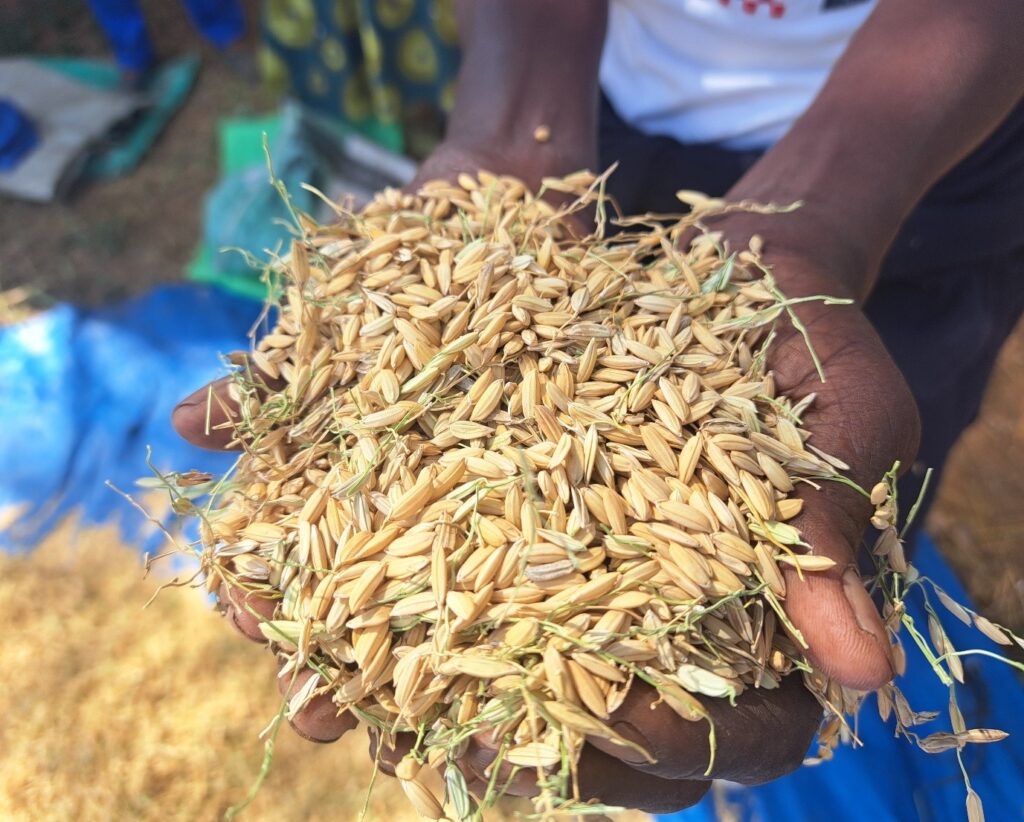
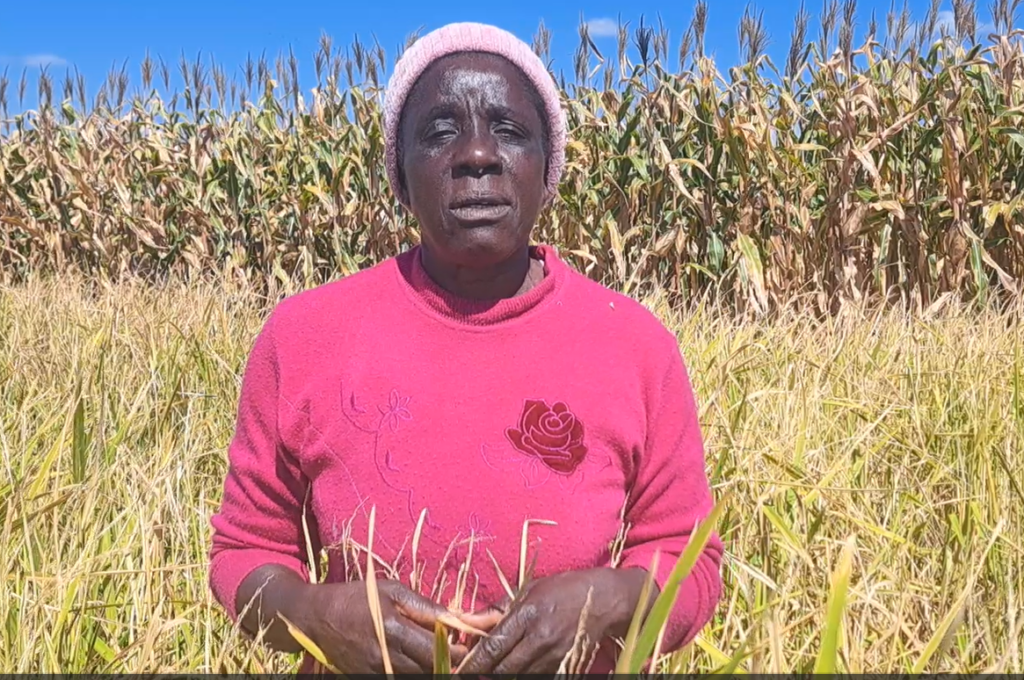
The Smallholder Agriculture Cluster Project established an upland rice demonstration plot in Exchange Irrigation Scheme in Midlands Province to cultivate the Nerica rice variety. The activity was carried out in partnership with Department of Research and Japanese International Cooperation Agency. Prior to the establishment of the demonstration plots, trainings were conducted to 126 farmers (61 males and 65 females) and 12 extension officers from different irrigation schemes on production of the upland rice. The purpose of the demonstrations were to make farmers aware of the production of upland rice and to produce rice seed to increase area under production.
The farmers were given seed and inputs for establishment of 200m2 plots. At Exchange Irrigation scheme, the 11 farmers who participated in the demonstration requested for more seed to plant 0.1 hectare and they were supported with inputs. The demonstration plot for Exchange irrigation scheme was harvested and the total production from the 0.1 ha plot was 260kg and this translates to 2.6 tonnes per hectare.
Commenting on their experience, one of the farmers at the scheme, Memory Shapure said, “When the trainers from the Department of Research first came, they advised us to make sure that our field is level. We then created lines using pieces of wood and wire. We planted 5kgs of rice in this plot. Our children love eating rice, I would definitely love to participate in future programmes to grow rice. We noticed that growing rice is not laborious or expensive. The fertilizer that needs to be applied to the rice is not much such that if you don’t have a lot of money, you can afford it.”
Mr Wellington Makura said, “We are pleased with the programme that we received from SACP and our extension officers, which allowed us to cultivate an alternative cereal crop. We planted Nerica 7 variety which has high yield potential. We planted our rice on the 25th of November 2024. Our rice germinated on the 3rd of December and we harvested our rice in April. Our yield was 262 kgs. Our trainers said 1kg of seed should give us 50kg yield so this was a successful demo for us.
I learnt that we can grow a variety of cereals as well as the fact that preparing rice is easy for our families. After working in the fields, rice is a quick and easy meal to prepare. Our children love rice and we no longer have to go to the shops to buy rice. We now have our own seed and we can expand the area under cultivation.”
Mrs Magaya said, “We initially thought growing rice was a difficult experience. After planting the rice, we soldiered on and managed to produce a good crop such that when we held our field day, many farmers expressed interest in growing the rice. We continue to get a lot of enquiries from fellow farmers on how they can get the seed for the rice. We are going to make money through the sale of the rice seed since many farmers want the seed. As you can see, we cultivated a small plot but we managed to get a good harvest.”
The extension officer for the irrigation scheme said, “When we first created the demo plot, there were about 47 farmers. As we continued with the work of establishing the demo plot, other farmers dropped off until 11remained. As extension officers, we realized that there is no need to force people to come and participate in the demo. Those who remained were committed, that is why you see that this demo was so successful.”
He added that, “I hear that a section of the irrigation scheme used to cultivate rice. This is a new crop that farmers have received well. We receive a lot of rain during the summer season for a short period, some crops fail to do well under such conditions. We think we can fully utilize those field to grow rice. Farmers can get a good rice harvest since those kinds of field were failing to produce rice. We have quite a number of such field and we hope that we can sell that rice to other communities.
This demo plot was for seed multiplication and we want this rice to be distributed to many more farmers within the scheme. We will prioritise farmers whose fields often get water logged. We will avoid fields that drain so much that they do not retain moisture as this may cause the crop to fail. We aim to put 10 hectares under rice, hence we need assistance to acquire a polisher to process the rice. The quantities we are anticipating to harvest after expansion of the area under irrigation may not be manually processed. We also have a vision where farmers will also package the rice and sell to shop owners.”