

From being established as a VBU providing portable water and watering livestock, and a group of farmers filled with hopes of improved household food security has grown into a thriving business enterprise for members of Mabhikwa Village Business Unit (VBU) in Lupane. Through teamwork, improved farming practices and continuous learning, the group is steadily increasing production, generating income and strengthening household nutrition.
Located on a 1.25-hectare garden, the Mabhikwa VBU consists 30 members, including women, men and youth, who work together to produce both commercial and nutritious food crops. One hectare of the garden is dedicated to commercial production, while a quarter of a hectare serves as a nutrition garden that supplies members with a variety of healthy vegetables for household consumption.
Despite a first crop that performed below expectations, the VBU treasurer Nomathemba Khumalo said the group’s second production cycle yielded encouraging results.
“We planted 2,500 cabbage seedlings in June 2025 and earned US$384 from cabbage sales. Our sugar bean crop performed well, producing 400 kilograms, which we sold at US$32 per bucket, generating US$265. Every member received US$20 from the proceeds, while part of the income was retained to purchase inputs for the next production cycle,” she said.
Chairperson Sithembiso Mahlangu said the VBU has consistently improved its performance over successive production cycles.
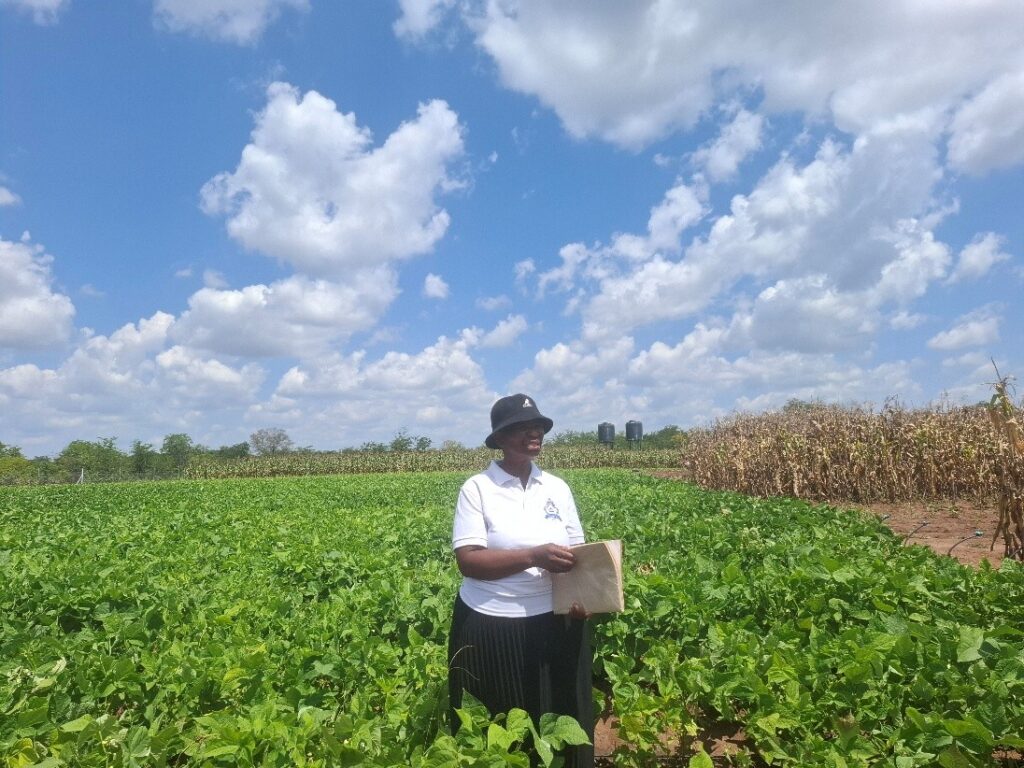
“In our third cycle, we grew green mealies and tomatoes. We earned US$609 from green mealies and US$575 from tomatoes. We shared the proceeds among members while reserving some funds to purchase inputs for the next crop. Those savings enabled us to plant the sugar bean crop that you see today. We also produced maize on 0.75 hectares, earning US$80 from fresh sales before sharing the remaining dried maize among members,” she explained.
The VBU has embraced a business-oriented approach by reinvesting part of its profits into future production, reducing dependency on external support while ensuring continuity of operations.
The VBU has been actively exploring cost cutting measures and the Secretary Jabulani Luphahla said the VBU has also reduced production costs by producing its own seedlings.
“We now propagate our own seedlings, including the Tengeru tomato variety, which is ready for our next planting. Producing our own seedlings has improved germination rates and reduced production costs. We are optimistic that the upcoming tomato crop will generate even better returns while also improving household nutrition,” he said.
The group’s success has been strengthened through regular engagement with agricultural extension officers and farmer-to-farmer learning exchanges.
A recent exchange visit to Jabatshaba Village Business Unit proved particularly transformative, exposing members to practical innovations that have improved productivity and resource management.
“We learnt the importance of proper water management,” explained Khumalo. “We now understand exactly how much water each irrigation block requires. Each block uses about 5,000 litres over 20 minutes before we move to the next. This allows us to irrigate all three production blocks efficiently while reserving another 5,000 litres for household use and watering livestock. Previously, we struggled to irrigate all the blocks in a single day.”
The exchange visit also reinforced the value of teamwork and effective leadership.
“We learnt the importance of working together as one unit and respecting one another, including the committee, regardless of age,” she added.
For Chairperson Mahlangu, one of the biggest lessons was improving seedling establishment.
“At Jabatshaba we learnt the correct procedures for preparing seedbeds. When we returned, we applied those methods to our cabbage and tomato nurseries, and our seeds achieved excellent germination,” he said.
Beyond generating income, the nutrition garden provides members with a steady supply of vegetables including cabbage, tomatoes, lettuce and leafy vegetables, contributing to improved household dietary diversity.

